

In December 2023, during a National Administrator Workshop in Lima, Peru, a deceptively simple question sparked what would become a transformative national initiative for the Argentine Badminton Federation (FEBARA): “What should we do today to build the badminton we want in a decade?”
For FEBARA, the answer became Proyección 2036 — a long-term programme grounded in the idea that the future of sport begins with children.
The programme was so successful that it would be awarded the BWF Membership Grant Programme Impact Award in April 2026. It highlighted how a clear vision — combined with collective dedication — could overcome the limitation of resources.
A Shift in Perspective
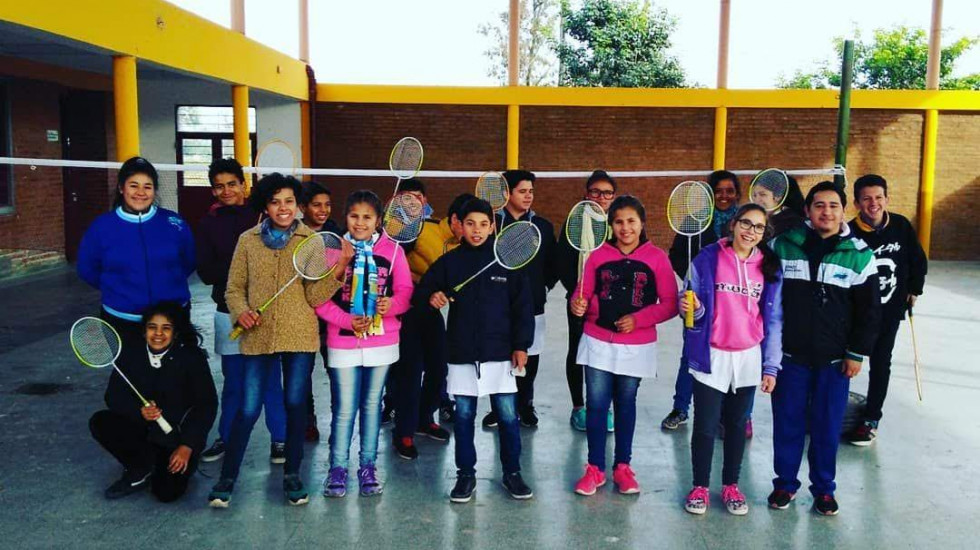
Traditionally, the federation’s efforts had not focused on the youngest age groups. Proyección 2036 changed that. Early on, it became clear that teaching children badminton required more than rackets and courts.
Using the BWF’s MA Grant, a programme was built on a holistic development model, integrating not only young players but also their families, schools, clubs, communities, and local governments. This approach recognises that sustainable sporting growth depends on the environment that surrounds the athlete.
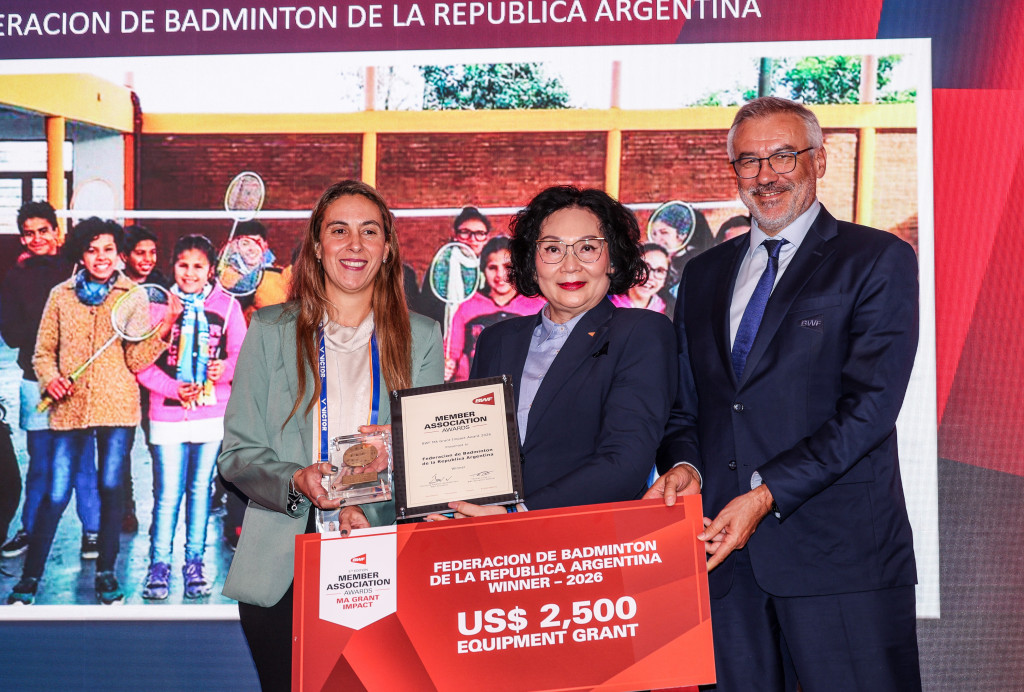
Prof. Mariela Parisi, Secretary of Argentine Badminton Federation, receives the BWF Membership Grant Programme Impact Award.
The programme sought to redefine the traditional concept of children’s events, with activities not conceived only as competitive events, but as platforms that combine sport, culture, local identity and family participation. The model also promoted coach education exchanges during events, encouraging peer learning and collaboration.
Supported by the BWF Membership Grant Programme, the initiative introduced educational tools, including a children’s storybook featuring mascots called Minton, Badmy, and Uma.
Uma, a wheelchair hare, raised awareness about inclusion and para sport for children. A children’s storybook with badminton-themed fables brought the sport closer to young participants.
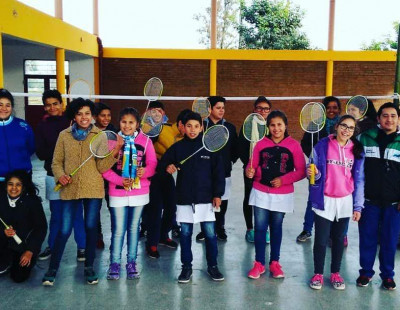
Within a year of its launch in 2024, six provinces and eight localities engaged in the programme. In 2025, three regional events and a major inter-provincial mini-badminton festival were conducted. In Santa Rosa, over a hundred children (U-9 and U-11) participated. A national event delivery guide was developed to systematise best practices.
“One of the programme’s most valuable aspects has been its ability to adapt to very diverse contexts,” said Daniel Pallarola, Vice-President of FEBARA. “Argentina is a vast country with very different regional realities. Proyección 2036 has made it possible to create a shared framework while respecting these local particularities, encouraging the participation of clubs, schools, local governments, and families.”
Beyond Medals: Measuring Impact
The success of Proyección 2036 is not measured solely by competitive outcomes. Instead, its impact is visible in growing interest in mini-badminton, stronger collaboration among affiliated organisations, expansion into new regions, and a vibrant and engaged badminton community.
Most importantly, children are forming lasting emotional connections with the sport — an essential foundation for long-term development.
Looking Ahead
The next phase of Proyección 2036 focuses on:
- Expanding territorial reach
- Enhancing coach and leader education
- Strengthening family involvement
- Developing richer learning experiences for children
Innovative approaches are also on the horizon, including research on adapted rackets tailored to children’s physical and developmental needs, and peer-learning programmes for coaches working with Under-9 and Under-11 categories.
These efforts reflect a commitment to continuous improvement and knowledge-sharing across the badminton community.
“Perhaps the greatest contribution of Proyección 2036 has been offering a vision of the future,” said Pallarola. “The programme has allowed many people to imagine that the development of Argentine badminton can be built in a planned, inclusive, and sustainable way. This idea has generated enthusiasm and commitment among different actors within the sports system.”
 BWF Newsletter