

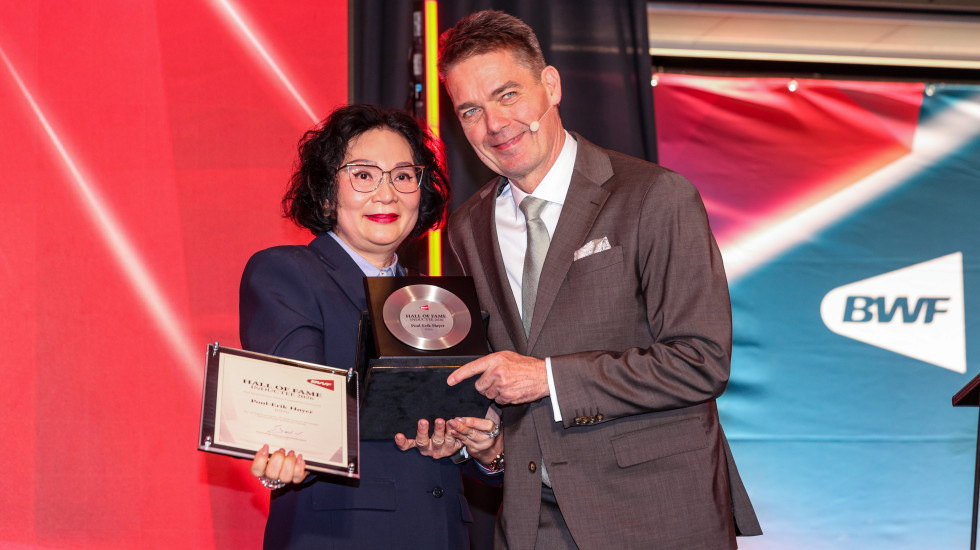
Even as he received the rare honour of being inducted into the BWF Hall of Fame on Saturday – becoming only the seventh administrator ever, and the first in 18 years – Poul-Erik Høyer referred to the values that had served him well all through his years as player and administrator.
“Fair play is very important,” the former BWF President said. The induction ceremony was held during the BWF Annual General Meeting in Horsens, Denmark.
“Also, resilience, how you can stand up against challenges and the ability to remain calm under pressure. That’s always something I’ve used as a player and as a politician.”
There was in this deference to fair play a reminder of the essence of sport; that a sportsperson or administrator should live up to higher standards rather than just subscribe to a “win-at-all-costs” attitude.
“It’s a great honour and a privilege to be nominated to the BWF Hall of Fame,” Høyer said. “To be recognised, not only for the years I spent on court, but also for the time dedicated to the governance of the sport, is very humbling. It gives the belief that the athlete’s contribution to the sport continues long after the final match is played.”
With Høyer, his leadership style was very much about reaching out and taking people along. It was a quality he had demonstrated all through his playing career, and even during his finest moment – topping the podium at the Atlanta Olympic Games in 1996. Observing his crestfallen opponent Dong Jiong, Høyer commiserated with him. The same empathy he took into his administrative career.
“I actually said to everybody that the door is open and they could give me input,” Høyer said, on his approach to leadership. “If they had anything to contribute, I would be happy and honoured to put that forward. It was very important for me to have an ‘open doors’ policy. You want to show and prove that it’s very important that you were listening to people.”
Standing for President of Badminton Europe (BE) in 2010, he won over the BE Council as soon as he addressed them the first time. The impression he made as BE President over the next three years paved the way for his Presidency of BWF in 2013 and becoming IOC Member the following year.
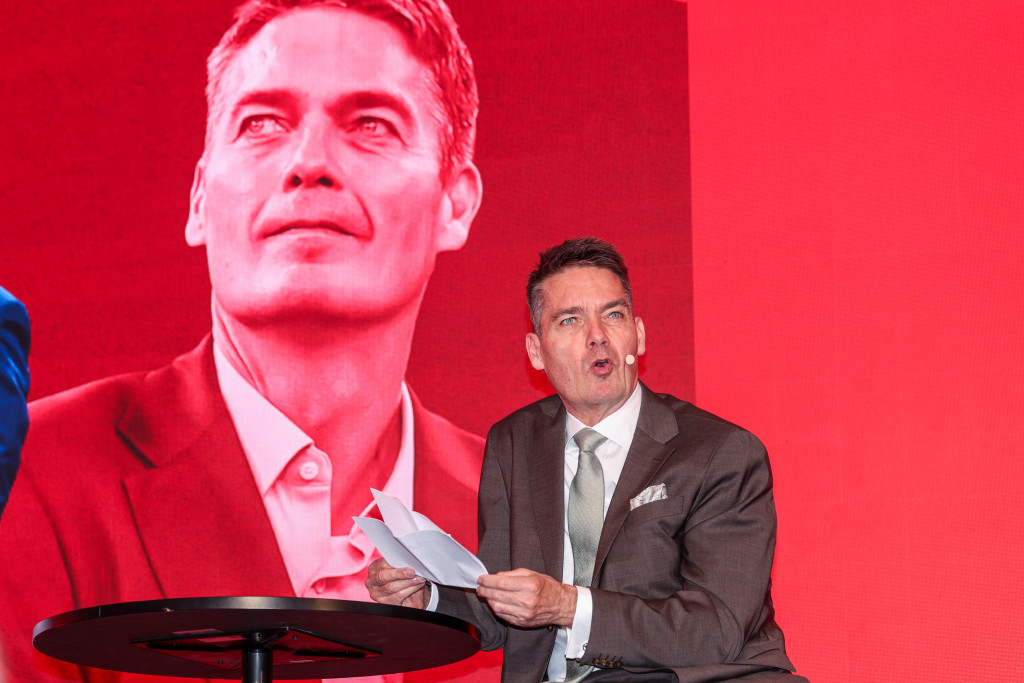
Høyer delivers his acceptance speech.
His willingness to listen to varied opinions and his non-confrontational approach were well in evidence during his three terms as BWF President – a period of success on multiple fronts, including strengthening badminton’s position at the Olympics, and commercial success with the BWF World Tour and the Major Championships. He was a passionate driver for Para badminton’s inclusion in the Paralympics, and that was to become a reality with its debut at Tokyo 2020.
The innovation of badminton as an outdoor sport happened during his tenure, enabling its adoption outside traditional badminton venues.
Of BWF’s achievements during his tenure, he is most proud of how well the organisation adapted to new challenges in a competitive world. “The digital transition has been very important. I believe that we have proven a lot as a sport with structural changes. We have been commercially viable and also proved that we are really on the right track, because we have transitioned ourselves in a very advanced environment. We have become a truly global sport, bringing ourselves up to No.2 or No.3 on the charts of good governance.”
What advice would he give to players who plan to take up administrative roles in their post-playing career?
As always, Høyer’s response revolves around values.
“Stay curious and stay humble. Those are two very important words. Status as a former champion opens doors. I believe that because of the results I got on court, it gave me the possibility to be supported. I encourage athletes to involve themselves in committee work or local administration early, because you have to start early in order to be part of the whole setup. It’s a complex ecosystem that allows professional sports to evolve. Don’t be afraid to step outside your comfort zone.”
 BWF Newsletter