

Most champions stand on the shoulders of past greats; their accomplishments a manifestation of the human ability to better the landmarks of their predecessors.
But there is no predecessor or precedent for Carolina Marin’s achievements. She was unique, a champion forged of her own iron will. And by the time she bid goodbye to badminton yesterday, she had left a heavy imprint on the sport – the kind of influence that makes a player a constant reference point, no matter how many years pass by. Only a few achieve that exalted status – the certainty that she represents the gold standard in any era.
For a player to emerge as an elite talent out of a badminton minnow nation, to even be in contention for a World Championships title, needed a badminton reimagining. This reimagining was to happen, apart from within Marin herself, in the mind of her coach Fernando Rivas – who said he was convinced he had a world champion on his hands the very first time he saw her.
The BWF World Championships 2014 title came out of the blue, for she hadn’t even won a Superseries until then, even though she had caused some ripples as Spain’s first European champion. Yet, even after that earthshaking achievement of beating the formidable Li Xuerui in the 2014 World Championships final, there was no hint that she would be one of badminton’s primary forces over the next decade.
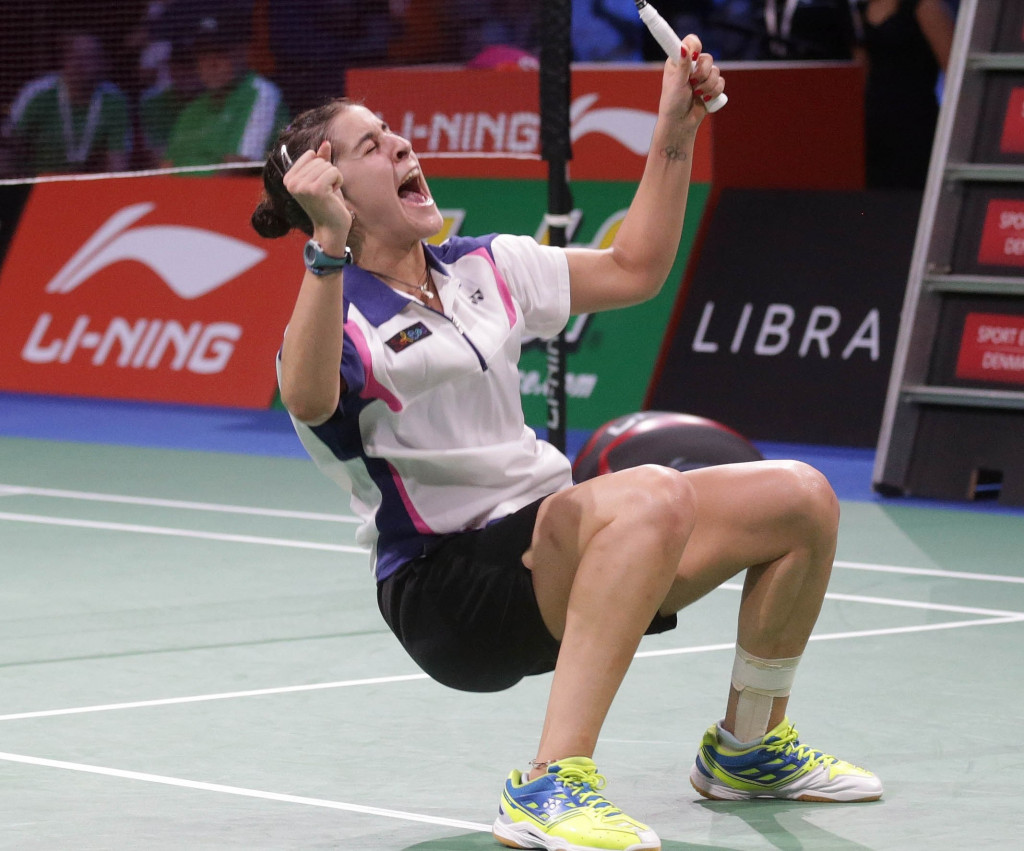
Marin’s winning moment at the BWF World Championships 2014.
All those doubts would be quelled in 2015, when, with five Superseries titles and her second World Championships crown, she would prove beyond a doubt that she was the gale force ushering in a new reality.
Everything about her game bristled with aggressive intent. Ratchanok Intanon would say that it was Marin who revolutionised speed in women’s singles. Marin’s chief quality was not just speed – it was high precision married to high speed and relentless attack. The shots were poison arrows delivered without respite. Then there was her personality, which was unapologetic in its celebration and vocal intimidation; her body language all hustle and bustle, no time spent between rallies that allowed opponents to catch a breath. It seemed, given all the disadvantages of her badminton upbringing – such as the absence of homegrown world champions that she could model herself on early – she had to squeeze every last bit out of herself.
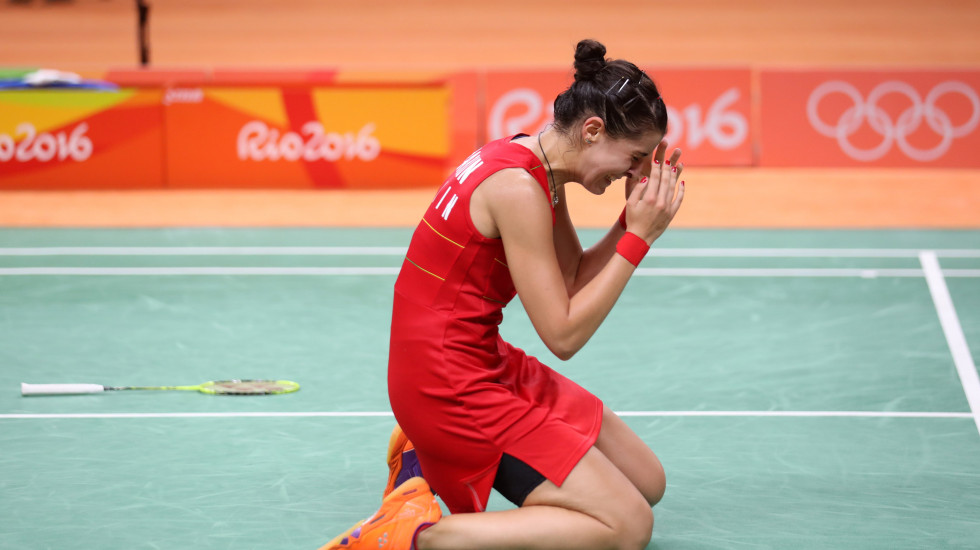
The 2016 Olympic final would bring this out in the starkest terms. The final was a pugilistic battle against an opponent who too was unhesitant to leverage her physicality – Pusarla V. Sindhu. The 83-minute long contest rivetted entire countries, bringing the physical dimensions of badminton to a worldwide audience – in later years, this match would often be recalled with wonder for its sheer intensity. For Spain, as indeed for every nation without the badminton legacy of the powerhouses, the gold would redefine their relationship with the sport.
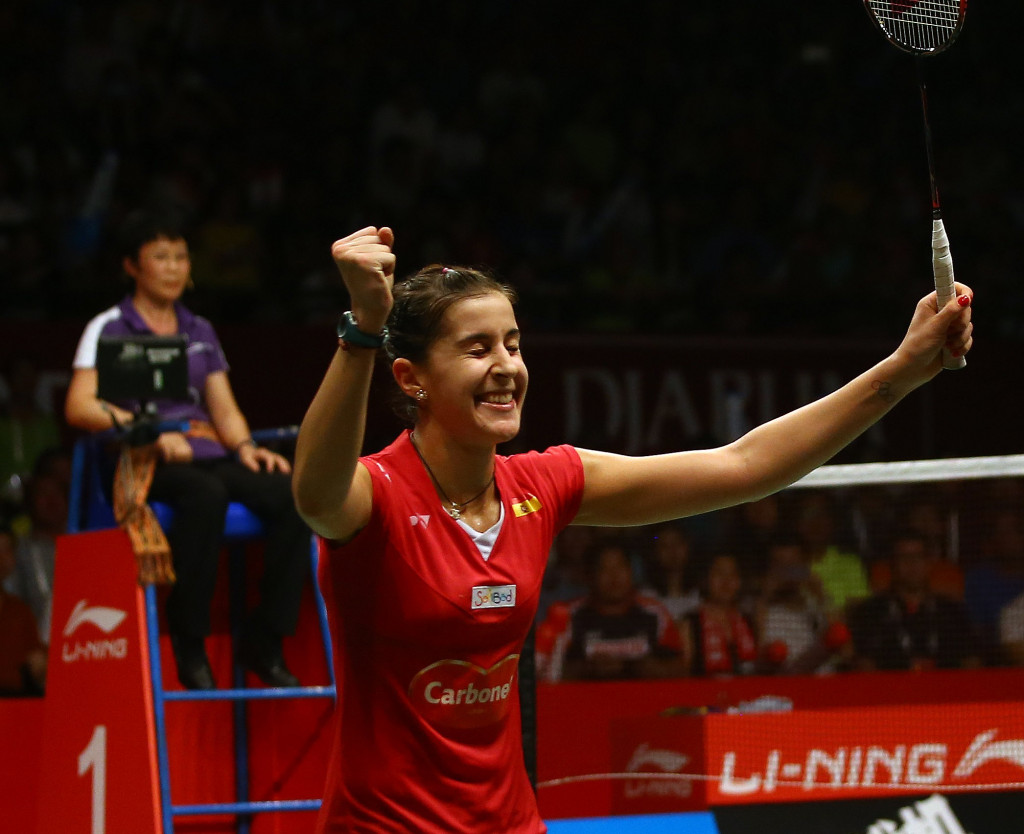
Celebrating the defence of her World Championships gold in 2015.
There would be many more memorable matches featuring the mercurial Marin. There would be a third World Championships title, which added to her legend, for she – a Spaniard – became the most successful women’s singles winner, until Akane Yamaguchi equalled her feat in 2025. Her dominance in Europe was unquestioned, with seven straight European titles. On the Superseries/World Tour, she would win nearly every major title except the season finale.
It was badminton’s good fortune that Marin came along during the golden age of women’s singles, which featured intense rivalries between purveyors of vastly different styles. Apart from Pusarla, there were players like Intanon,Tai Tzu Ying, Sung Ji Hyun, Saina Nehwal, Yamaguchi, Nozomi Okuhara, Li Xuerui, Wang Yihan, Wang Shixian, Chen Yu Fei, Michelle Li, Beiwen Zhang and a clutch of others who all elevated women’s singles above that of any other category of the time.
Marin’s later career would be dogged by serious knee injuries, necessitating her withdrawal from the defence of her Olympic gold and her home World Championships in 2021. Yet, it is a mark of the steel she possessed that her comeback from those injuries would see her in a fourth World Championships final, and an almost-certain Olympic final in 2024. Leading He Bing Jiao comfortably in their semifinal at Paris 2024, Marin would collapse in pain, her final goodbye on the biggest stage of all.
Yet, having redefined women’s singles and elevated it, Marin is not just a part of its past, but its present and future.
 BWF Newsletter